.png)
One that would Endure
One hundred seasons later, the radical vision of two women continues to shape Carmel's cultural life.

On the Monterey Peninsula, a centennial is more than an anniversary. It is evidence of a community that has spent generations believing that art is worth building institutions around.
The leaves above Stokes Adobe rustled gently as evening began to settle over Monterey. A breeze moved through the trees carrying the first suggestion of autumn, while laughter and the low hum of conversation drifted toward the front walk. Boxwoods guided us toward the two-story adobe, its historic white columns rising toward the dark wooden balustrade above.
It was an appropriate place to begin an evening devoted to history.
Stokes Adobe occupies a house built in 1833, a place whose nearly two centuries have been remarkably restless. Originally constructed for trapper Ambrose Tomlinson, it later became the home of James Stokes and, through successive chapters, served as a bakery, pottery kiln, military garrison and print shop associated with the printing of California's first newspaper. By the middle of the twentieth century, it had become Gallatin's, a fashionable restaurant drawing Hollywood personalities and business figures. Through nearly every incarnation, the building has remained what it is again today: a place of congregation.
Inside, that history has been given a contemporary polish without sanding away its character.
We entered through the bar, where bottles glowed amber against black cabinetry and a circular light hovered between them like a small moon. White-painted beams carried the eye upward. Beyond, old books filled recessed shelves around an intimate dining table; another room opened onto black-framed windows and a wall of greenery outside. Along the staircase, candles punctuated dark wood and white spindles with pools of warm light.
Dinner unfolded easily. We began with mocktails and crispy potatoes, followed by a Little Gems salad for Jennifer and Chicken Milanese for me. Key lime pie closed the meal, decadent and bright, before we stepped back into the evening and drove north toward Sand City.
There was something almost too perfect about beginning a centennial celebration inside a building that had already survived nearly two.





The Peninsula's Centennial Moment
One hundred years has become something of a recurring number on the Monterey Peninsula.
The Carmel Music Society is beginning its 100th season, while the Carmel Art Association approaches its own centennial year, set to mark the occasion with a Gala Ball Masque at the historic Hotel Del Monte. These are separate institutions, born from different disciplines, yet their longevity points toward the same larger story.
The Peninsula has not simply attracted artists.
It has built structures that allow art to endure.
That distinction matters.
During the evening at SandBox, the significance of so many local cultural organizations arriving at similar anniversaries was raised. It suggested something larger than a single centennial: a community capable of sustaining music, visual art, theater and performance across generations. As was observed that evening, artists from around the world regard performing in Carmel as an honor, drawn not only to the Peninsula's physical beauty but to the cultural life that has been nurtured here for generations.
Tonight, that century-long continuum had gathered inside SandBox Sand City.

A New Room for an Old Idea
Sand City provided a fascinating counterpoint to where our evening began.
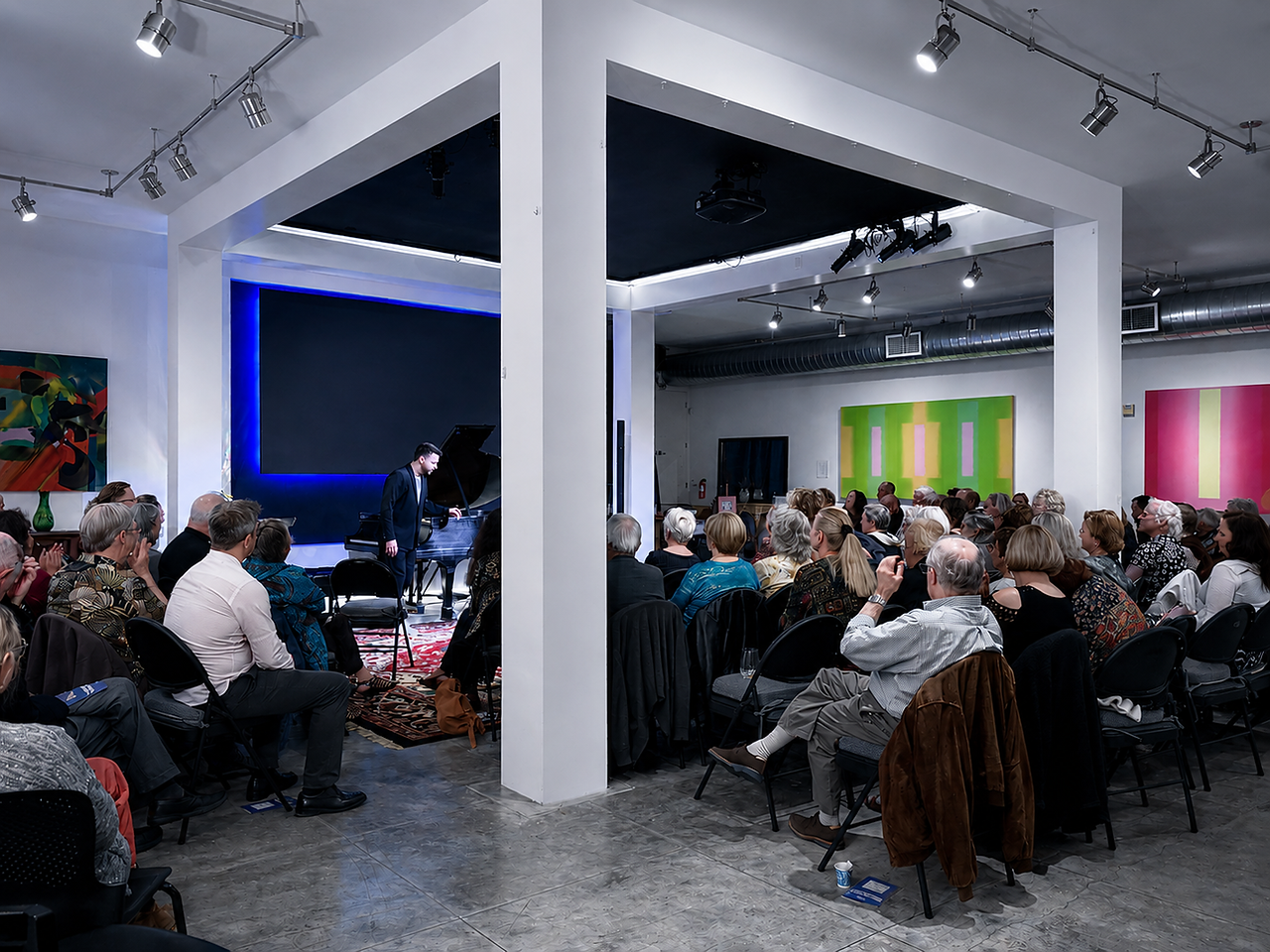
Stokes Adobe carries history in thick walls, timber and worn floorboards. SandBox is industrial, spare and unapologetically contemporary. Concrete floors stretch beneath exposed mechanical systems; white walls become enormous planes for art. Rows of chairs transform what could easily be mistaken for a warehouse gallery into an intimate concert hall.
SandBox is still a comparatively new venture, yet it has already established itself as a world-class setting for intimate performance. There is little separation between artist and audience here. Music is experienced at close range, surrounded by visual art and the architecture of a working contemporary space.
At the center of SandBox is its founder and artistic director, Michelle Djokic, a world-class classical cellist whose vision has shaped the venue into something far more fluid than a traditional concert hall. Djokic curates a program that moves comfortably between the classical canon and more contemporary musical expressions, allowing genres to meet rather than remain neatly separated. Under her direction, SandBox has become a place for experimentation, intimacy and unexpected pairings, where music exists in conversation with visual art, architecture and audience. It is an approach that feels particularly suited to the Peninsula, honoring its artistic traditions while continually finding new ways to make them feel alive.
For Carmel Music Society, the pairing feels effortless.
Its Carmel Music Stage 2 concerts use SandBox precisely for this intimacy, complementing the Society's larger performances while offering another way of encountering the music.
And then there were the walls.
Works by Lucas Blok and Greg Hawthorne transformed SandBox from performance venue into something more immersive, surrounding the audience with color before the first note was played.
Against the gallery's spare white walls and exposed industrial architecture, the two artists offered distinctly different visual rhythms. Greg Hawthorne's figurative work commanded the entry wall, two figures emerging through an exuberant construction of turquoise, violet, coral, green and electric blue. The bodies appear almost assembled from fragments, their forms shifting between figuration and abstraction.
Across the room, Lucas Blok's abstraction spoke in a different language. Bands of saturated pink, punctuated by vertical passages of luminous yellow-green, reduced the composition to color, proportion and repetition. Its apparent simplicity only heightened its presence against the white wall.
Soon, the music would give both works another dimension.


Before the Century
To understand what Carmel Music Society represents today, one has to return to two women who arrived in Carmel determined to make things happen: Hazel Watrous and Dene Denny.
Their story was recounted that evening by historian and author David Gordon, whose research reveals something considerably more interesting than the polite origin story one might expect from a century-old cultural institution.
Watrous, born in Visalia in 1884, trained as an artist and became an art educator. Denny, born the following year in rural Northern California, graduated Phi Beta Kappa from the University of California, Berkeley and became an English teacher and accomplished pianist. For years, remarkably, the two commuted in opposite directions across San Francisco Bay without knowing one another.
Then both independently arrived at essentially the same conclusion.
They were finished merely teaching creativity. They wanted to practice it.
Hazel wanted to make art. Dene wanted to perform. They eventually met in San Francisco and became inseparable creative and business partners.
When they came to Carmel, they were not passive participants in its emerging artistic experiment.
They helped shape it.
Gordon described them as artistic radicals. Denny was devoted to the most progressive music of her time, even performing the American premiere of Arnold Schoenberg's Piano Pieces, Op. 23. Together, the women designed and built 36 cottages in Carmel-by-the-Sea. Their Harmony House was conceived with a central room specifically intended for performances, lectures, chamber music, exhibitions, dramatic readings and poetry.
They were artists, educators, builders and impresarios. Their creativity refused to remain within the borders of a single discipline.
Architecture, visual art, music, conversation and community were part of the same proposition.
A century later, sitting inside SandBox surrounded by contemporary art and waiting for two musicians to perform only feet away, that philosophy felt startlingly current.
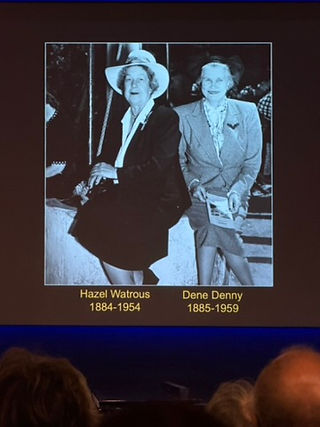


"One That Would Endure"
By the 1920s, Carmel already had musicians and patrons. What it lacked was continuity.
Concerts happened privately and individually. Patrons might bring a quartet, pianist or singer to Carmel for an evening, but afterward the artist departed and the enterprise dissolved. There was no sustained concert series capable of attracting important musicians year after year.
Watrous and Denny recognized the problem as organizational rather than artistic.
On October 20, 1927, they invited people from Carmel, Monterey and Pacific Grove into their studio to discuss, in the language recorded in the original minutes, "Carmel's chances for music in the future."
The conclusion was simple and remarkably prescient.
The community needed an organization. A strong one.
"One that would endure."
The name Carmel Music Society was chosen soon afterward.
On December 9, 1927, the Society presented its first concert, featuring Canada's Hart House String Quartet, then one of North America's leading ensembles.
The experiment worked.
More than 700 concerts followed across the Society's first 99 seasons. Its early decades alone brought an astonishing procession of artists to Carmel, including Marian Anderson, Jascha Heifetz, Yehudi Menuhin, Rudolf Serkin, Igor Stravinsky, Gregor Piatigorsky, Martha Graham and the Vienna Boys Choir. In 1937, the Society also sponsored the first Carmel Bach Festival.
What Watrous and Denny built was not simply a concert series.
They helped establish the expectation that a small village perched against the Pacific could participate seriously in international culture.

The Next Note
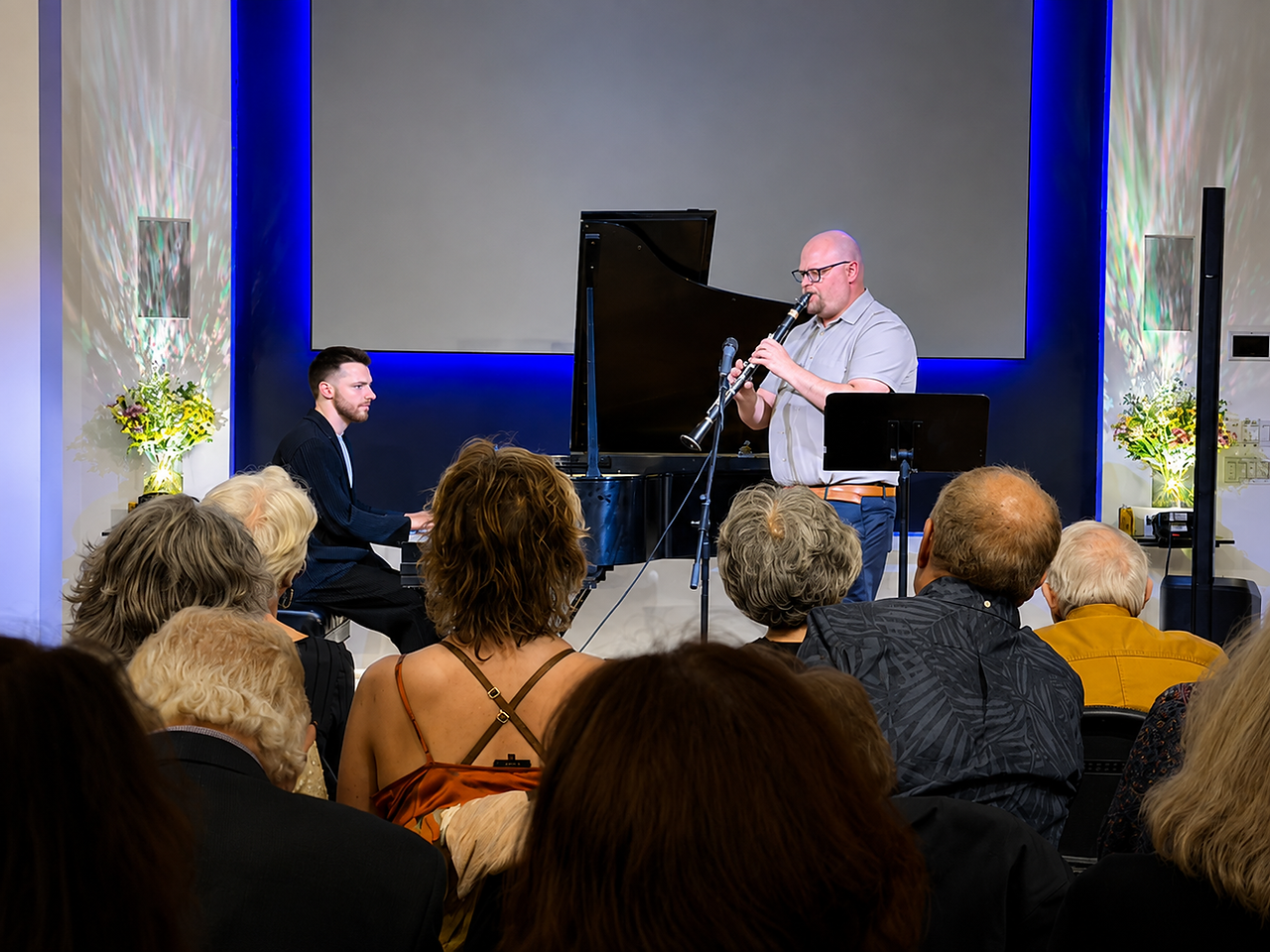
A century later, Mark Dover and Peter Dugan were an inspired pairing to carry that idea forward.
Grammy Award-winning clarinetist Mark Dover is a musician whose career resists tidy categorization. Firmly grounded in classical music yet equally comfortable within improvisation, he has served as clarinetist of Imani Winds since 2016 and joined chamber ensemble yMusic in 2023. His orchestral appearances have included the Atlanta, Baltimore and Albany symphonies and the American Composers Orchestra.
His work with Imani Winds contributed to the ensemble's Grammy-winning Passion for Bach and Coltrane, which received Best Classical Compendium at the 2024 Grammy Awards, while his collaborations with artists including Vulfpeck reveal another side of a musician interested in what can happen when the borders surrounding classical music become porous.
At the piano, Peter Dugan shares that appetite for possibility.
Pianist, composer, collaborator and host of NPR's From the Top, Dugan moves comfortably among classical, jazz and popular idioms. His career has taken him onto stages across North America and abroad, both as soloist and chamber musician, while collaborations with artists including Joshua Bell, Renée Fleming, Itzhak Perlman, Charles Yang and Paquito D'Rivera reveal a musician whose curiosity extends well beyond conventional repertoire.
More important that evening was the relationship between them.
Before Dover and Dugan appeared, they were introduced not simply as distinguished performers but as close friends, with the audience invited to listen for the chemistry produced by two musicians who know, respect and trust one another.
That chemistry quickly became audible.
Dover could make the clarinet feel almost vocal, moving from a rounded, burnished tone into phrases that darted, bent and occasionally seemed to wink at the audience. Dugan was less accompanist than conspirator. The piano supplied architecture one moment and provocation the next, allowing phrases to loosen and tighten with the instinctive timing of conversation.
And suddenly, the contrast between the paintings surrounding them seemed to acquire rhythm.
Hawthorne's fragmented figures appeared almost to move as Dover's clarinet shifted between lyrical passages and flashes of agility. Across the room, Blok's bands of color began to feel like measures in a score: repetition, interval, pause.
Figuration and abstraction. Color and sound. Structure and improvisation.
The musicians themselves seemed interested in precisely that kind of crossing between worlds. At one point, they described part of the program as a "sonata tasting menu," moving into the finale of Francis Poulenc's Clarinet Sonata while discussing the fascinating lineage surrounding the music and its connections to Benny Goodman and Leonard Bernstein.
There was sophistication in the music, but also freedom. Classical structures remained visible, but there was air around them. Improvisational instinct brought elasticity to the phrasing; moments of technical brilliance arrived without announcing themselves as demonstrations.
From only a few rows away, the physicality of performance became part of the experience: breath entering the clarinet, fingers moving over silver keys, Dugan's hands crossing the keyboard, the nearly imperceptible glance between musicians before a phrase turned.
Around Dover and Dugan, the works of Lucas Blok and Greg Hawthorne continued their own silent performance. Hawthorne's figures seemed increasingly animated by the music, their fragmented planes of turquoise, coral and blue shifting with each change in tempo. Across the room, Blok's saturated bands of pink and luminous yellow-green provided a quieter visual cadence, almost a score reduced to color.
Dover sent another phrase into the room; Dugan answered at the piano.
The walls seemed to answer back.
For a few minutes, it was difficult to determine where one experience ended and another began. The music seemed to animate the paintings, while the paintings gave the music a visual register of its own.
SandBox itself had become part of the composition.



What Endures
Perhaps that was the most compelling part of celebrating 100 seasons of Carmel Music Society.
The evening never felt embalmed by its history.
It felt alive because of it.
The same impulse that moved Hazel Watrous and Dene Denny to build cottages, open galleries, create performance rooms and gather neighbors around music remains visible across the Peninsula today. It exists in cultural institutions approaching their own centennials. It exists inside a contemporary space in Sand City where musicians perform beneath paintings by living artists. It exists in audiences who continue to fill chairs because they believe experiencing art together still matters.
Carmel Music Society President Eric Dyar, opened the evening by acknowledging how unusual such longevity is, crediting generations of volunteers, board members, patrons, donors and audiences with carrying the founders' vision forward.
That may be the deeper cultural story here.
Carmel-by-the-Sea is celebrated endlessly for its coastline, cottages and improbable beauty. But beauty alone does not produce a century of music.
People do.
People decide that painters need walls, musicians need rooms, audiences need places to gather and institutions need protecting long after their founders are gone.
It is difficult not to think again of Watrous and Denny.
A century ago, the two women were designing cottages with rooms large enough to accommodate music, poetry, lectures and art. On this evening, a century later, another room had been assembled around essentially the same proposition: paintings on the walls, musicians before an audience and a community gathered together to experience both.
The architecture had changed.
The idea had not.
Nearly a hundred years ago, Watrous and Denny decided Carmel needed something strong enough to endure.
It did.
And as the final notes moved through SandBox and dissolved into the room, surrounded by paintings that seemed still to hold some residue of the music, the evening felt less like a commemoration of what had been accomplished than an opening gesture toward what comes next.
One hundred seasons behind it. The next note already sounding.


Comments