.png)
Structured Chaos: Keith Lindberg on Limitation, Balance, and the Eye

A soft breeze billows in from the northwest, brushing against the edge of morning. The clouds hang low, heavy with quiet intention, obscuring the distant coastline. It is that suspended hour when the day has begun but has not yet declared itself. Light arrives slowly. Not in beams, but in a diffusion. A pale gold slipping through layers of blue.
Six figures gather in silence.
They are arranged as if by instinct rather than design, each turned toward the east, toward an unseen horizon. Their bodies carry a stillness that feels less like rest and more like waiting. One leans forward, elbows anchored, chin resting in thought. Another turns slightly away, as if listening for something carried on the wind. There is a quiet tension in their posture, a shared anticipation that hums just beneath the surface. It is not difficult to imagine ships beyond the veil of fog, returning. Or perhaps not returning at all.
Hope and despair sit side by side at the table.
The table itself is cloaked in white, its surface luminous, almost sacred. Upon it rests a quiet arrangement of forms. A cone. A sphere. A rectangular block. Their geometry is deliberate, yet softened by the painter’s hand. Edges dissolve into color. Shadows melt into fields of blue and violet. A vessel of deep crimson catches the light, its surface vibrating with warmth against the cooler tones surrounding it. Oranges and reds pulse gently within the composition, like embers beneath ash. And there, woven through it all, a distinct and electric hue, a blue that does not belong to sky or sea, but something entirely its own.
The air feels salted. The silence feels shared.
A brushstroke shifts, and suddenly the illusion loosens.
The breeze behind me becomes real. The hush breaks into quiet conversation. The low murmur of voices gathers like a tide returning to shore. I step back, and the horizon collapses into canvas. The figures flatten into paint. The ships dissolve into suggestion.
I am standing inside the Carmel Art Association, looking at a painting by Keith Lindberg.

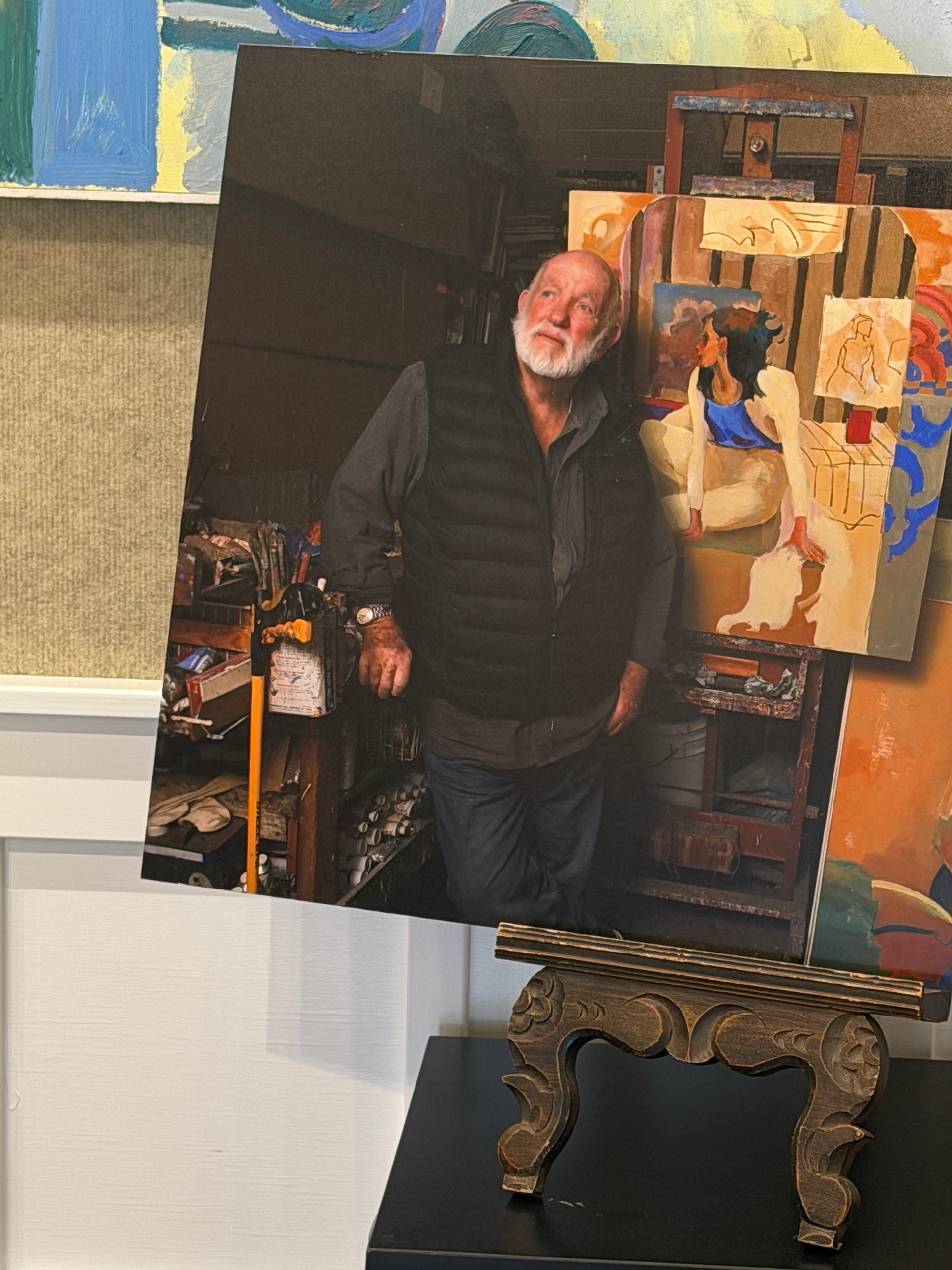
For over six decades, Keith Lindberg has remained a constant presence within Carmel’s artistic landscape. His exhibition, Journey, serves as both reflection and culmination. A small retrospective, yet expansive in its reach, the show traces a lifetime of inquiry through the human form, still life, landscape, and animal studies. Born in Kansas City and shaped by his time at the Kansas City Art Institute and the Art Institute of Chicago, Lindberg emerged from an environment that valued experimentation over instruction. That ethos never left him.
“My work is the result of exploration,” he notes. And in speaking with him, it becomes clear that exploration, for Lindberg, is not a phase. It is the foundation.

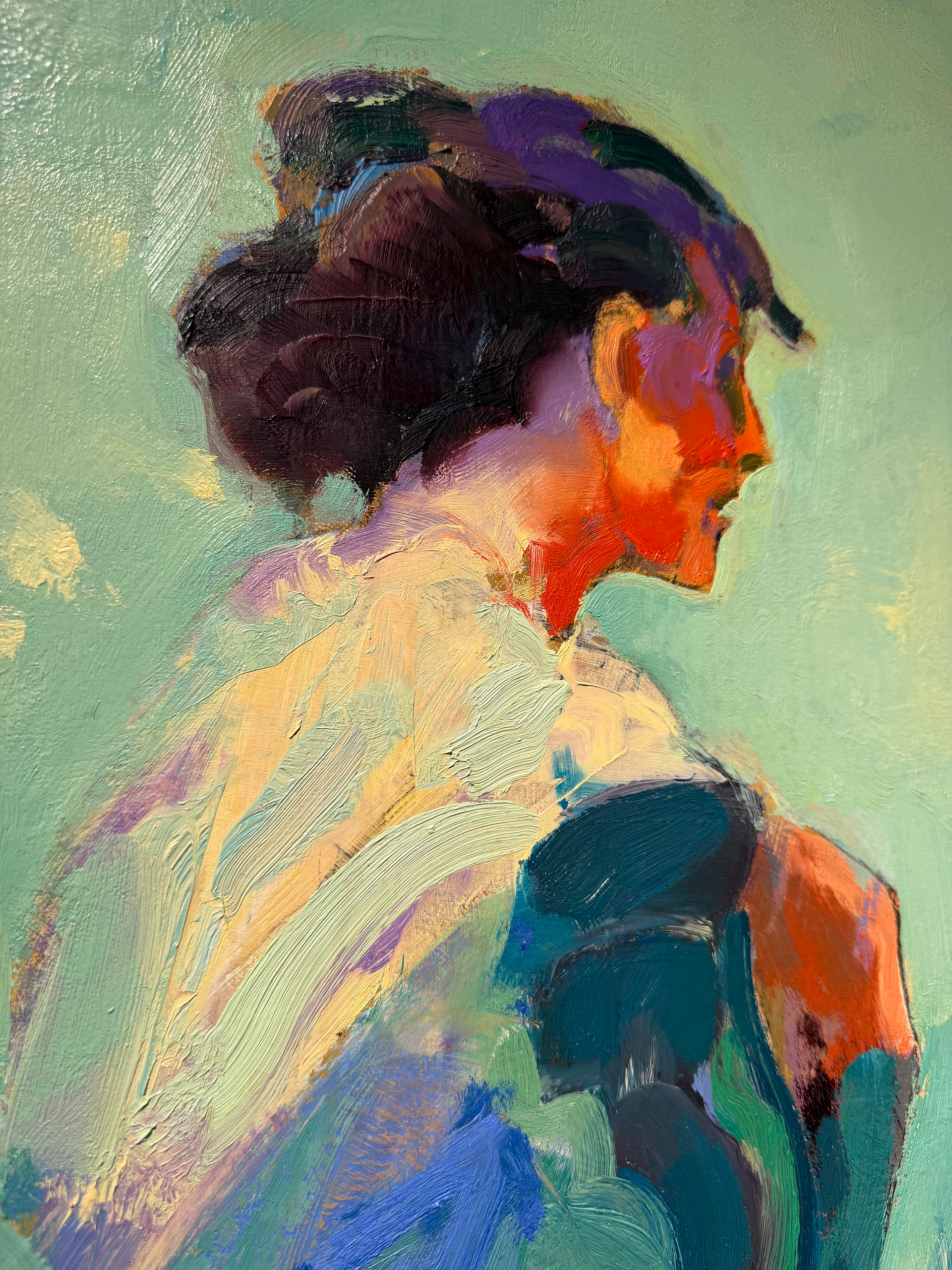
During his talk, the room becomes saturated with color. Not just visually, but energetically. His paintings, spanning from the mid-1960s to present day, surround the audience in a chorus of orange, blue, red, and radiant whites. They do not sit quietly on the walls. They pulse. They insist. They invite you in, but only halfway.
Because, as Lindberg explains, he only provides half the painting.
“We don’t see things as they are. We see them as we are.”
It is a simple statement, but it reframes everything. The figures in his work are not portraits. They are structures. Symbols. Anonymous forms upon which the viewer projects their own narrative. When asked who these figures are, Lindberg turns the question back. What do you see? The answer, whatever it may be, is correct.
In this way, his paintings are less about depiction and more about participation.


Central to Lindberg’s philosophy is the concept of limitation. Not as restriction, but as refinement. Early in his career, he made a decisive choice to separate what belonged in his work from what did not. Realism, for instance, was eliminated entirely. Not out of inability, but out of disinterest. For Lindberg, realism is decoration. His work seeks something deeper. Something more personal.
These self-imposed boundaries become the framework through which freedom emerges.
Over time, those limitations evolve. They are not fixed. They are tested, stretched, redefined. “You have to advance your limitations,” he explains. Like a sculptor returning to the same block of stone, carving away, revealing new facets of form. Through this process, the work becomes an accumulation of self. A visual record of who the artist is, and who he is becoming.
And yet, within this structure, there is chaos.
Lindberg speaks of it with a kind of reverence. Not as something to be avoided, but something to be orchestrated. His paintings begin in disorder. Loose gestures. fragmented forms. marks that feel almost accidental. Then, slowly, he brings them back. Not fully. Just enough.
“I like to mess with chaos… then organize it just enough so you see the figure.”
This is what he calls structured chaos. A delicate calibration between spontaneity and control. Too much order, and the painting becomes rigid. Too much chaos, and it dissolves entirely. The balance is intuitive. Felt rather than measured.

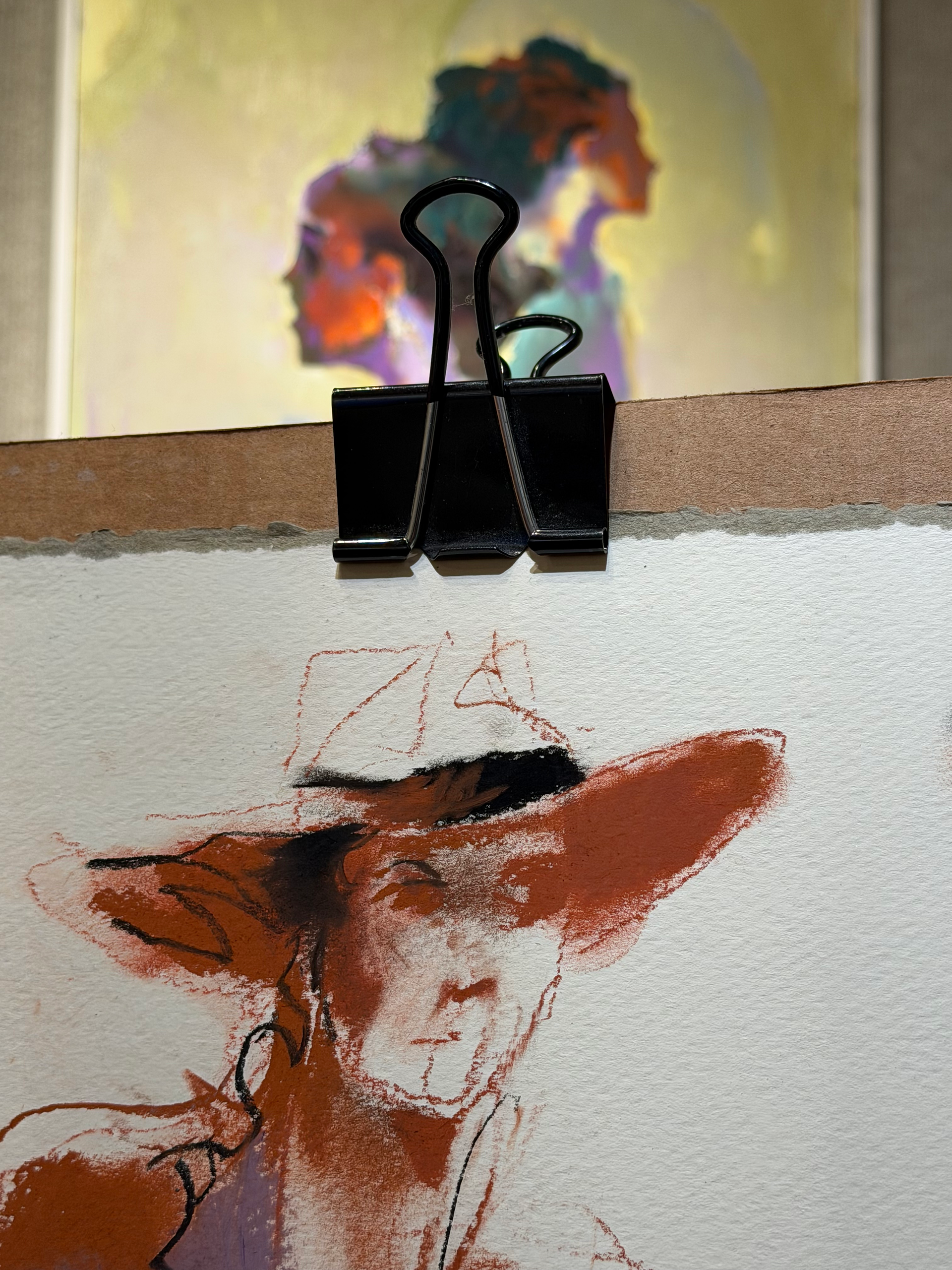
You see it in the work. In the way a figure emerges from a field of abstraction. In the tension between a clean edge and a fractured one. In the way color is both contained and allowed to wander.
There is also an element of rebellion woven into his process.
Lindberg often references classical “canons” of painting, only to dismantle them. Where tradition dictates a certain path for the eye, he redirects it. Where proportion is prescribed, he disrupts it. Not out of defiance, but curiosity. What happens if you invert the rule? What new problem does that create?
For Lindberg, painting is not about arriving at an answer. It is about generating questions worth solving.
Even his tools reflect this mindset. At one point in the talk, he casually mentions using a belt sander on his canvases. Not as a novelty, but as necessity. There are textures, he explains, that cannot be painted. They must be revealed through abrasion. Through removal. It is another form of chaos. Another layer of control.
And then there is the eye.
Perhaps the most grounding concept in his philosophy.
While the mind searches for story, Lindberg insists that it is the eye that determines whether a painting endures. A compelling narrative may draw you in initially, but it is the visual balance, the harmony of color, form, and proportion, that keeps you returning.

“You buy a painting because of the story,” he says, “but you live with it because of the eye.”
It is a quiet truth. One that settles into the room as viewers begin to reconsider their own relationship with the work around them.
As the talk draws to a close, the space feels altered.
Not physically, but perceptually.
The same paintings remain on the walls, yet they seem to hold more. Or perhaps, you are bringing more to them now. The figures no longer feel anonymous. They feel familiar. Not because they have changed, but because you have.
The colors linger. That unmistakable blue hums beneath the surface of memory. Reds flicker at the edges of thought. The whites, once stark, now feel expansive. Breathing.




Outside, the breeze carries on. The clouds shift. The day continues its ascent.
And somewhere between what was painted and what was perceived, something remains suspended. Not a conclusion, but an invitation.
To look again.
To question what you see.
And to consider, quietly, what it says about you.
To explore the full collection and discover available works, visit the exhibition online: https://carmelart.org/artist/keith-lindberg


Comments