.png)
The Curious Palate
An evening of art, appetite and conversation in Carmel-by-the-Sea

The car pulled up beneath the towering white walls of Kimpton Mirador Pacific Grove, their Spanish Revival forms rising above Fountain Avenue beneath a terracotta roofline. The architecture felt distinctly Californian, with arched openings, pale stucco and the geometry of the building catching the final light of the day.
As the valet opened the door, the Pacific announced itself first. Cool salt air drifted in from the coast, followed by the warmth of the late August sun washing the hotel's white façade in a shade somewhere between apricot and dusty rose.
Beyond the doors came another sensory layer: the soft collision of voices, glassware and introductions. Writers, chefs, editors and creators from around the world had gathered over wine, cocktails and small bites for the beginning of an evening called The Curious Palate.
The name would prove particularly apt.
This was an evening built around curiosity, but also around the idea that culture is rarely experienced through a single sense. We look at a painting. We taste a dish. We touch a textile. We listen to someone explain why they made something. Yet the most memorable experiences happen when those boundaries begin to disappear.
On August 27, that conversation unfolded between Pacific Grove and Carmel-by-the-Sea, moving from hotel to artist's studio, studio to gallery, and finally gallery to table.
Among the crowd was artist Jennifer Perlmutter, dressed simply in a white button-down shirt and black pants, a multicolored shawl falling across one shoulder. It was beautiful but seemingly incidental. Hours later, inside her studio, we would learn it had been a gift from her mother.
It was the first of many details that evening that would acquire meaning only after we had been invited to look closer.


Behind the Canvas
After cocktails, private buses carried the group south toward Carmel-by-the-Sea.
There is something wonderfully cinematic about arriving in Carmel this way. The scale contracts. Streets narrow. Buildings recede beneath trees. Courtyards appear between storefronts, and one begins to understand why this tiny village has spent more than a century attracting painters, writers, musicians and people who seem compelled to make things.
Our destination was not initially a gallery, but the place before the gallery: Jennifer's studio.
Located only minutes from her Carmel space, the second-story studio overlooks a canopy of treetops near and far. Inside, brushes crowd vessels on worktables. Paintings lean against walls. Flowers share space with jars of pigment and tools carrying the evidence of previous canvases. The room feels less like somewhere art is displayed than somewhere ideas are still allowed to be unresolved.
Jennifer gathered us around her worktable and began to speak.
Here, the shawl made its reappearance in the story. A gift from her mother, it became one small example of how objects accumulate meaning, how memory attaches itself to color and material, and how an artist's visual vocabulary is rarely separated from the life being lived around it.
The setting made her words more intimate. Outside the windows, Carmel's trees filled the view. Inside, unfinished canvases, brushes, flowers and works in progress surrounded us.
Perlmutter works predominantly in mixed media on wood and canvas, building surfaces through color, texture, layering and abstraction. Her work has been exhibited and collected internationally, while her practice has also explored the relationship between creativity and innovation.
Listening to an artist speak while standing among the instruments of her practice changes the way you later encounter the finished work. A painting ceases to be merely an object hanging on a wall. You begin searching its surface for decisions.
Perhaps that is the real value of an artist talk. It does not tell you what to see. It teaches you to slow down enough to notice.


From Studio to Gallery
We followed Jennifer from the private language of the studio into the public language of the gallery.
Jennifer Perlmutter Gallery sits in the Millard Building on Dolores Street between Fifth and Sixth, tucked into one of the village's characteristic courtyards. Artist-owned and operated, the intimate gallery is devoted principally to Perlmutter's recent work and projects, with occasional guest artists and programming.
Now the pieces we had heard discussed in their place of creation were illuminated against gallery walls.
The transition was revealing.
In the studio, paintings existed among brushes, tables, flowers, scraps and other works. Here they were given space. Color expanded. Texture became more pronounced. Individual canvases commanded their own conversations.
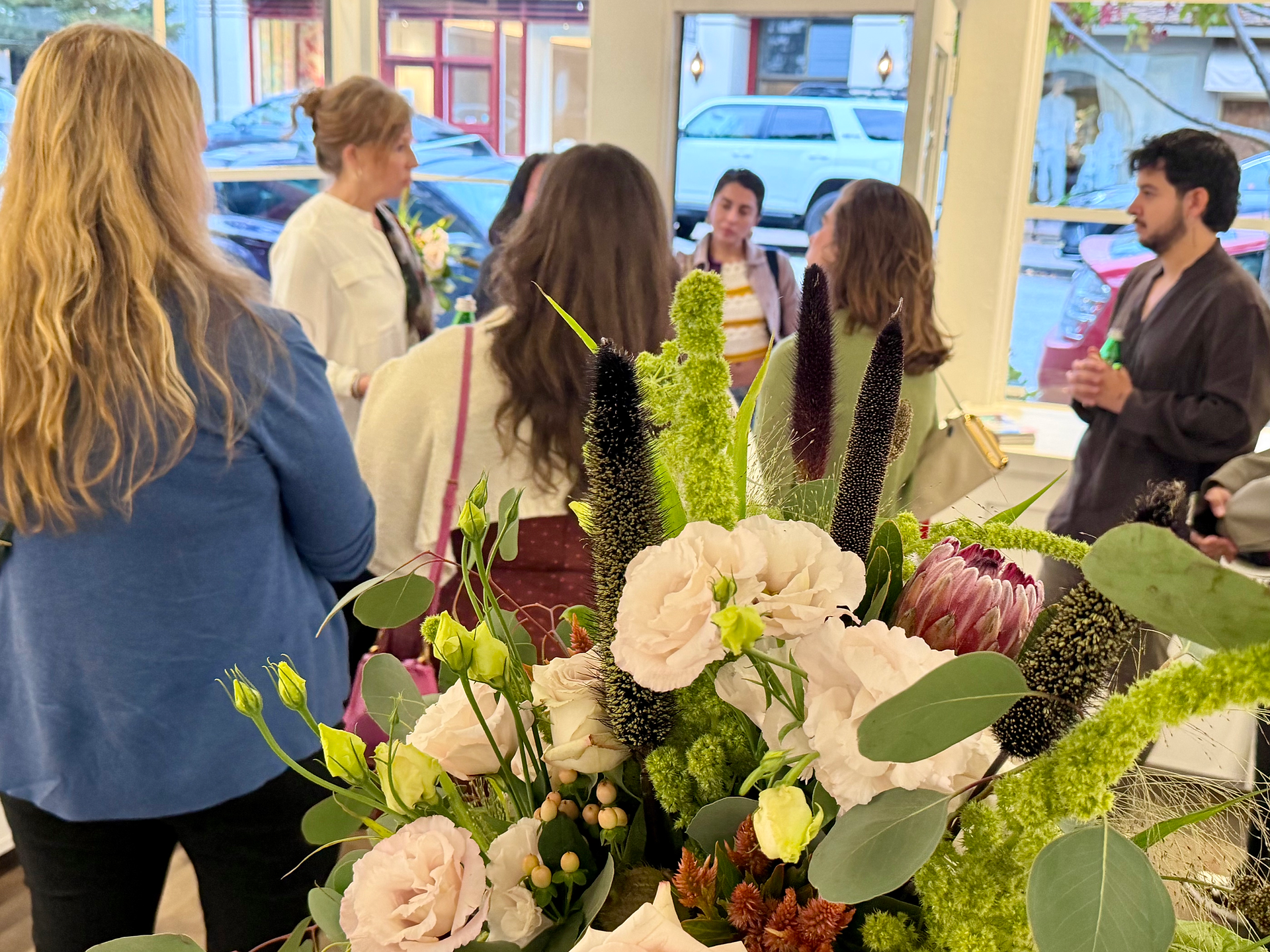
Guests moved through the room with the looseness of people who had just been granted access to the backstory. Conversations continued beneath the paintings. Details from Jennifer's talk resurfaced. Questions became more specific.
Copies of the HAUS of HITE Guide to Carmel-by-the-Sea were waiting for guests, another layer in an evening concerned with understanding place through the people creating within it.
And Carmel was quietly making its argument.
For a gathering of international writers, chefs and cultural storytellers, there could hardly have been a more fitting setting. Carmel's identity has long been intertwined with art, architecture, food, craft and a distinctly human scale. Here, culture rarely requires a grand building or formal procession. It is discovered behind courtyard gates, up staircases, inside studios and across tables.
That evening, we simply walked to the next chapter.




The Table as Canvas
From the gallery, the group made its way to Stationæry, where the visual language changed again.
Paint gave way to porcelain. Brushes to forks. Canvases to plates.
We settled around wooden tables beneath candlelight, surrounded by wine glasses catching small reflections from the room. The evening had become more intimate. Chairs shifted closer. Bottles opened. Conversations that had begun hours earlier found new participants.
Our table decided almost immediately that ordering individually seemed contrary to the spirit of the night.
We would eat family style.
And so plates began moving between us.
Pacific Gold oysters arrived first, nestled against smooth black stones with a small vessel of Lindera Farms elderflower vinegar mignonette at their center. They were cool, saline and unmistakably of the coast, the elderflower bringing a delicate aromatic acidity to the brine.
Then came heirloom tomatoes with burrata di Puglia, sweet basil and sourdough breadcrumbs, a dish built around late-summer abundance.
The bluefin tuna crudo was more electric. Deep ruby slices of tuna were punctuated by glossy Asian cucumbers, cilantro, mint, Thai chile and peanuts. Coolness, heat, softness and crunch occupied the same plate.
It was difficult not to think back to Jennifer's studio.
Layer upon layer.
Texture against texture.
Contrast creating composition.
The parallels between painter and chef were becoming increasingly difficult to ignore.
A summer corn pasta with chanterelles, brown butter and burrata followed, almost monochromatic in its palette but deeply expressive in flavor. Golden kernels tangled through pasta alongside chanterelles, while the burrata softened into the warmth of the dish. It tasted unmistakably of the fleeting weeks between high summer and autumn.
There was cod salad, followed by skirt steak served blushing pink beneath a generous tangle of herbs and delicate shavings of cheese. Plates crossed the table. Someone reached for another oyster. Wine was poured. A fork appeared from the opposite side of a dish.
The formality of a curated dinner had gradually given way to something much more interesting: participation.


A Table of Storytellers
The people around the table made the meal as compelling as what was being served.
Two chefs offered a particularly fascinating perspective on the evening. Chef Andrés Cárdenas, chef at OL Restaurant in Mexico City, and Chef Andres Gallegos, who is preparing to open Hierbazal restaurant and tortillería alongside Savia Wine Bar.
To eat alongside chefs while discussing an artist's process adds another dimension to dinner. Food is no longer simply consumed. Technique enters the conversation. Ingredients have provenance. A plate can be considered through composition, restraint and intention, much as we had been considering Jennifer's paintings only an hour earlier.
Around them sat people whose professions are built upon observing and translating culture for others: Amber Love Bond, a freelance writer whose work includes Forbes and Travel + Leisure; Kristin Conrad, who writes for Islands and The List; Kelsey Stewart of The Zoe Report; Nayeli Estrada of Food & Wine en Español; and Daniela Gutiérrez of M of Milenio.
What made the group inspiring was not simply the publications or cities represented. It was the collective curiosity at the table.
These were people accustomed to arriving somewhere unfamiliar and asking questions. What is being made here? Who is making it? Why does it matter? What does this place taste like, look like, sound like? And how do you translate an experience for someone who was not there?
For one evening, Carmel became both subject and host.

A Gazebo's Second Life
Even the room carried another Carmel story.
Our table sat within a refurbished gazebo once home to Bee Bark & Moss, the deeply personal shop created by Philip Rodrigue and Minori Shironishi. Their store has since moved only a few doors away, where their handmade bags and textile pieces mingle with an evolving collection of objects sourced from Big Sur and farther afield.
That continuity felt important.
In Carmel, spaces rarely seem to lose their stories entirely. They accumulate them.
A former shop becomes part of a restaurant. An artist's shawl becomes part of a talk. A studio becomes the key to understanding a painting. A local ingredient becomes an introduction to a landscape.
And a dinner becomes a way of understanding a town.

The Curious Palate
By the end of the evening, the title had become less about food than about a way of moving through the world.
A curious palate is not simply interested in what tastes good. It wants context.
It wants to know where something came from, whose hands shaped it, what memory informed it and why it could only have happened here.
Jennifer's paintings offered one answer. The dinner offered another.
Both began with raw material. Both depended upon composition. Both asked their maker to understand when to add another layer and when to stop. Both transformed familiar elements through perspective. And both were completed, in some sense, by the person standing before them.
That is perhaps why Carmel-by-the-Sea felt so culturally relevant to this particular gathering. The village still allows disciplines to brush against one another. Artists, chefs, designers, writers and craftspeople occupy the same few walkable blocks. A studio visit can become a gallery opening, which can become dinner, which can become a conversation carried late into the evening.
For a group accustomed to traveling the world in search of stories, the revelation was not necessarily something new.
It was something increasingly rare.
Culture at human scale.
As the final plates were cleared and candlelight flickered against half-empty wine glasses, I thought again about Jennifer's studio: the brushes crowded together, the roses beside them, the unfinished work waiting quietly against the walls.
Hours earlier, we had been invited to see how an artist builds an image.
By dinner's end, it felt as though Carmel had shown us how a place builds a culture.
One brushstroke, one plate, one conversation at a time.


Comments