.png)
Breathing Life Into Carmel’s Hidden Courtyard
Updated: Mar 19

There are some people who pass through a place, and then there are those who listen closely enough to hear what it’s been waiting to become.
For Tracie Zelei-Rossi, the courtyard behind Cottage Row was never just an overlooked pocket of space. It was a quiet conversation unfolding over time, shared between two friends on a balcony, suspended above a garden that had yet to find its voice. Where others may have seen neglect, she felt something else entirely, a kind of emotional gravity, a pull toward possibility. The withered vines, the emptiness, the stillness. It wasn’t absence, but anticipation.
What followed was not simply a redesign, but an act of devotion. Guided by intuition and an enduring connection to nature shaped long before Carmel, Tracie approached the courtyard as both canvas and collaborator. Her vision unfolded in layers. Structure and softness, discipline and spontaneity, each plant chosen not just for how it would look, but for how it would feel. The result is a garden that breathes, one that invites pause, connection, and quiet joy.
At the heart of it all is something deeply human. Friendship. Memory. A shared sense of meaning that now lives within the space itself. What Tracie has created is not simply a garden, but a living expression of care, where every bloom carries intention and every corner offers the gentle reminder that beauty often begins with someone choosing to see what others overlook.
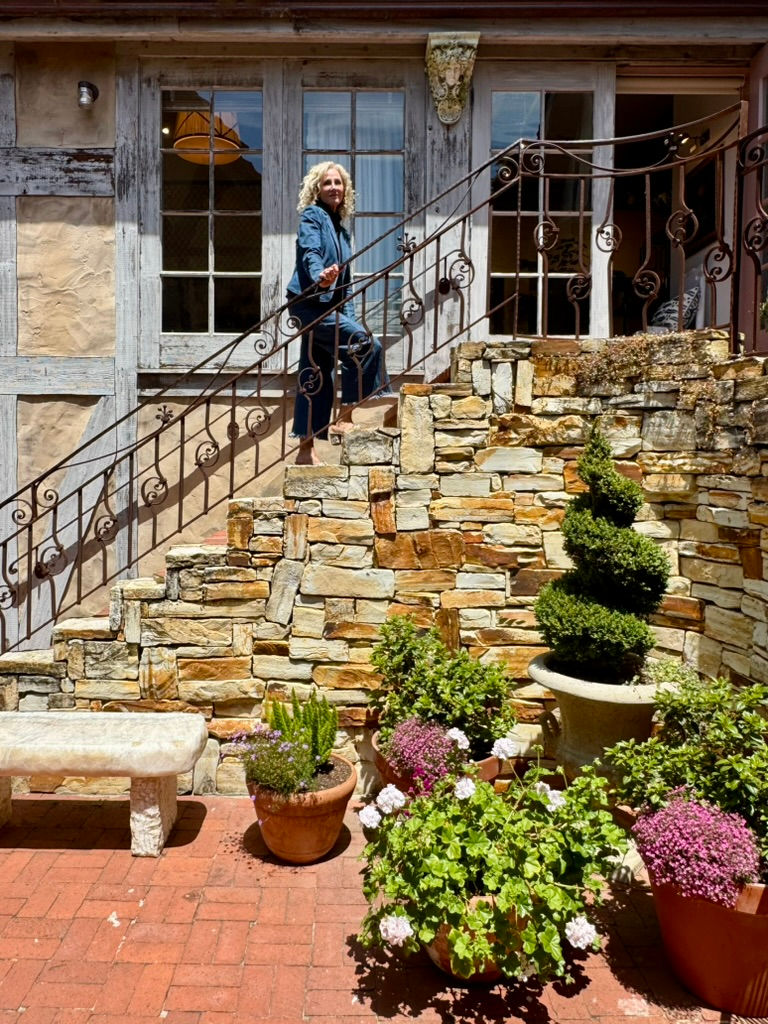
The courtyard behind Cottage Row has long felt like one of Carmel’s quiet secrets. What first inspired you to imagine it as something more intentional, and how did the idea of revitalizing the space begin to take shape?
A good friend and neighboring colleague, Shelly Littlewood, and I spent many hours together on the balcony overlooking the courtyard, our doors opening toward one another. It became a place where our friendship took root, shaped by long conversations and a shared appreciation for the stillness of the space below.
Over time, I found myself increasingly drawn to the courtyard itself. I’ve always felt a pull toward architectural and garden spaces that seem to be asking for care, and this one carried a kind of quiet heaviness. Looking down, I saw only a few struggling plants, dead vines clinging to one of the larger walls, and expanses that felt unresolved. It held a sense of pause, almost as if it were waiting to be reimagined.
I began to picture something different, a lush, flowering garden that could soften the space and bring it back into rhythm. One day, almost without thinking, I said aloud to Shelly, “I’m going to landscape this courtyard.” It felt less like a decision and more like answering something that had already been there.
As the vision evolved, it became important to me that the space reflect the community it serves. The courtyard is shared by five women whose work surrounds it, each bringing her own perspective and presence. I wanted to honor that in a meaningful way, imagining five female statues woven into the garden, each one representing the women connected to the space: Alexis Smith of Studio Shoshin, Kristina Hawley of Hart Habitats, Robin Sevrina Olson of Host House, Monica Graham of Monica Graham Fine Art, and Patricia Terwilliger of Jones & Terwilliger Gallery.
The intention was to create not just a garden, but a sense of quiet unity, a space where their individual practices could coexist within something living, evolving, and shared.


The courtyard now carries an official name, giving the space a new identity within the village. Can you share the story behind how that name emerged and what it represents to you?
The name Lucky Heart Cottage Court is an expression of how Shelly and I both feel about the courtyard, lucky in heart and spirit. To understand why this is true for us, I must first share how our connection to the space began.
After I declared my vision, received authorization to improve it, and set to work designing the space, Shelly approached me shortly after her mother’s passing. She shared that she had been wanting to donate money in her mother’s honor to something in Carmel, as the town held special meaning for her. She said she could think of no better way to honor her mother’s spirit than by contributing to this project.
She then offered to donate funds beyond what had been authorized by the owner for new plants, allowing the true essence of the courtyard to come to life. Her generosity made it possible to embellish the space with additional beautiful pots and a white quartzite bench, which we engraved in honor of her mother and father.
Together, we began to consider names that could reflect how the space made us feel. We kept returning to the same sentiment. We felt lucky to share such a heartfelt project, and even more so to have our two hearts brought together through the act of creating it.

Your work with florals often feels less like decoration and more like storytelling. When you began envisioning the plant life for the courtyard, what kind of emotional atmosphere were you hoping the space would hold?
I wanted the plant life in the courtyard to evoke the feeling of a peaceful English garden. Organized, but not rigid. Flowering, but not unruly. A space grounded in green throughout the year, both energizing and restorative.
I envisioned a place that would gently draw people out from their businesses and into a shared moment, somewhere to gather as a community, to connect, or simply to sit quietly for a pause during the day.
To achieve this, I layered the structure and formality of topiary with flowering plants, cascading vines, and delicate, colorful weeping maple trees. The surrounding stone walls, ornate ironwork, and the rustic wood and stucco of the architecture create a natural backdrop, allowing these elements to come forward in a way that feels both composed and distinctly European in spirit.

Flowers clearly play a central role in your creative language. Do you remember the moment or period in your life when you first realized florals would become such an important medium for you?
I grew up with an incredible grandmother who taught me the art of setting a beautiful table for the holidays, always anchored by a homegrown floral arrangement at its center. My mother was happiest at home, tending to her garden, surrounded by flowers in bloom. Through them, I was raised to appreciate nature in all its forms, and I have always felt more at ease outdoors than within four walls.
My connection to floral design, however, did not begin with intention. I started creating bouquets for the shop simply as an outlet for a kind of creativity that felt as though it had nowhere else to go at the time. What surprised me was how deeply I enjoyed it. I love the way flowers feel against my bare hands, their fresh scent, and the diversity of their forms. Each stem carries its own presence, contributing to the arrangement in a way that feels essential, like an orchestra where every note matters.
Customers responded to them in a way that felt immediate and genuine, often sharing how the arrangements brought them a sense of happiness. Over time, I began to notice something unexpected. I would find myself unconsciously singing as I worked, as if the act of arranging was bringing something to life beyond what I could see.
Gradually, I came to understand that their essence is intertwined with my own. There is a quiet dialogue between us, a shared energy that feels both intuitive and deeply connected.


When building a space like this, how do you balance spontaneity with structure? Is there a moment when the garden begins to guide you rather than the other way around?
The guidance of the garden begins in a practical sense, considering elements like shade and sun, as well as the spatial relationships of height and scale. The plan is never fixed and almost always evolves as the project unfolds.
Spontaneity enters in quieter ways, when an intended plant is unavailable and I am drawn to something unexpected, or when a particular flower catches my attention at the nursery and feels right in the moment.
I would say the garden leads first, through its overall essence and natural character, and I respond by shaping its structure, allowing for a touch of spontaneity along the way.
Carmel-by-the-Sea has always been a village shaped by artists, writers, and makers. In what ways does that creative history influence how you approach projects like this courtyard?
Carmel is a creative’s candy store. The architecture, hidden passageways, uneven sidewalks, weathered wood, galleries, and those ever-changing ocean and sky views all invite a sense of discovery.
To be surrounded by such natural beauty each day is a constant source of inspiration, one that quietly shapes the way I see, create, and move through the world.


The best hidden spaces in Carmel often feel discovered rather than designed. How did you preserve that sense of quiet discovery while still transforming the courtyard into something new?
This courtyard is tucked away from the main walkways and streets, offering a level of privacy that often feels like complete solitude. It tends to reveal itself only to those willing to wander, down narrow alleyways and staircases, or to those who find it through the shops that quietly open onto it from behind. There is something undeniably magical about its subtle presence.
Gael Gallagher, through her walking tours of Carmel, has developed a particular appreciation for the courtyard. Its unmarked nature allows her to share it as a hidden discovery, something unexpected within the village. She has also embraced its renewed life and takes great joy in pointing out the design to her guests, while celebrating its architectural beauty. Her support has been both generous and meaningful.

What do you personally love most about Carmel-by-the-Sea, and how does the landscape or community here continue to inspire your work?
I love the sense of community in Carmel, the natural beauty, the historic architecture, the care taken to keep it clean, and the ever-present creativity. It reveals itself in small and unexpected ways, from floral surprises peeking through the cracks of a weathered fence to galleries filled with color and expression.
I’m inspired by the people who sit along Scenic, painting the landscape and pausing to connect with passersby, the charming man who sings opera as he walks the streets, and the devotion people have to their dogs, who seem to be welcome everywhere.
There is something in the air here, a shared intention to preserve what makes Carmel so special. It is a place shaped not only by its beauty, but by the people who care deeply for it, and by the friendships that naturally form within it.


Now that the courtyard has been revitalized and named, what do you hope people feel when they wander into the space for the first time?
To witness the expressions of those who stumble upon the courtyard is truly priceless. I hope it always remains a magical surprise, a place where people pause, smile, and feel a sense of delight as they take it in.
I love watching them call out to their friends, inviting them closer, and then seeing their reactions as they descend the stairs and arrive at the center, turning slowly to absorb the space in its entirety. There is a quiet sense of awe in that moment.
Some are drawn to sit beside a flowering plant, others make their way up to the balcony, and many pause to take a photo with Flora, the Greek goddess of plants and florals. Each person seems to find their own way of engaging with the space.
To be able to offer even a brief moment of joy, harmony, and lighthearted connection among the plants and flowers is what makes my heart sing.

In the end, Lucky Heart Cottage Court is more than a garden tucked behind Cottage Row. It is a reflection of what has always defined Carmel at its best, a place where creativity is not confined to canvas or gallery walls, but lived, shared, and quietly offered to others. Through Tracie’s hands, this once-forgotten space has become a living expression of care, where friendship takes root, memory is honored, and beauty is allowed to unfold in its own time.
It reminds us that the spirit of Carmel is not something preserved, but something continually created, often in the most unexpected corners, by those willing to see what could be, and to bring it gently into being.



Comments